
A blade near your face sounds like the opposite of a relaxing spa day. It’s a fair first reaction and one that keeps a lot of people from trying a treatment they’d genuinely love. So, here’s the short answer: yes, dermaplaning is safe. When it’s performed by a skilled esthetician, with the right technique and proper aftercare, it’s one of the gentler, more effective exfoliation treatments available.
The longer answer is that safety—like most things in skincare—depends on context. The right provider, the right timing, and a clear understanding of your skin all matter. At Thrive NOLA Spa, we believe informed guests make the best decisions, so here’s everything you need to know before you book.
What Is Dermaplaning and How Does It Work?
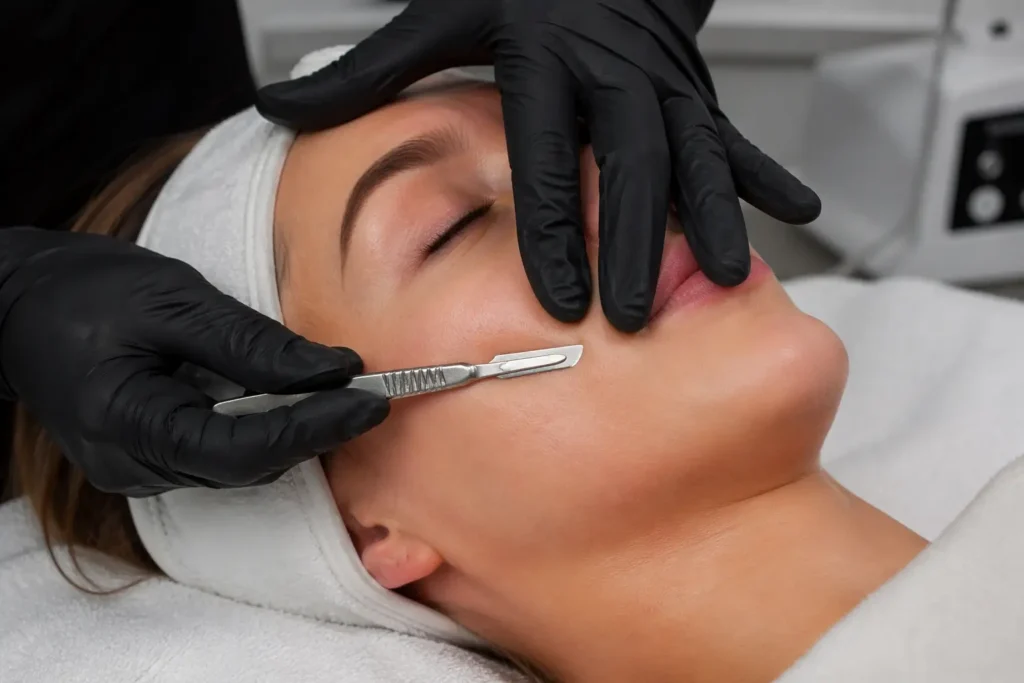
Dermaplaning is a manual exfoliation treatment in which a trained esthetician uses a sterile, surgical-grade blade to gently remove the outermost layer of dead skin cells along with vellus hair, which is the fine, soft peach fuzz that covers most of the face.
The process is more controlled than it sounds. Your esthetician holds the skin taut and glides the blade at a precise angle across the surface in short, careful strokes. There’s no heat, no chemicals, and, when done correctly, no discomfort. Most guests describe it as feeling like a gentle scraping sensation, not unlike the drag of a dull credit card edge across skin.
The result is a noticeably smoother surface, a brighter and more even tone, and skin that’s primed to absorb serums and moisturizers far more effectively.
When performed by a skilled esthetician, dermaplaning is considered a safe and well-tolerated treatment for most skin types; the key phrase being “performed by a skilled esthetician,” which we’ll come back to.
Key Benefits of Dermaplaning
The appeal of dermaplaning is largely in the immediacy of its results. Unlike some treatments that require patience, this one delivers:
- Instant smoothness: skin feels different the moment the treatment is done
- A brighter, more even tone from the removal of dull surface buildup
- Noticeably better product absorption: serums and moisturizers sink in more effectively on a freshly exfoliated surface
- A smoother canvas for makeup application: foundation glides on with none of the peach fuzz interference
- Gradual improvement in the appearance of fine lines and uneven texture through stimulated cell turnover
- No chemicals and no heat: a strong option for guests who want real results without more aggressive treatments
One more thing worth clarifying up front: vellus hair grows back at the same rate and with the same texture it always has. Dermaplaning does not cause hair to grow back thicker or darker. That’s a persistent myth with no basis in how vellus hair actually works, and it shouldn’t be a reason to hold back.
Potential Risks and Side Effects
Transparency here is important. Dermaplaning is safe, and it also comes with a few things worth knowing about beforehand.
The most common post-treatment experiences are mild and temporary:
- Light redness or flushing immediately after, which typically fades within a few hours
- Slight skin sensitivity or dryness in the days following, as the surface adjusts
Less common, but possible: minor irritation or breakout activity if aftercare isn’t followed closely, or if skin is treated too soon after another exfoliating procedure. These outcomes are significantly less likely with a professional than with at-home tools, technique, blade quality, and preparation all play a meaningful role in the result.
For most guests, downtime is minimal to none. You leave looking refreshed, not red.
Who Should Avoid Dermaplaning
Dermaplaning isn’t for everyone in every moment, but the list of people who truly can’t benefit from it is shorter than most assume. The more common situation is a timing issue rather than a permanent incompatibility.
It’s best to skip dermaplaning—at least temporarily—if you’re experiencing:
- Active acne or inflamed breakouts; the blade can irritate already-compromised skin and isn’t ideal for open lesions
- Active rosacea flare-ups or a significantly sensitized skin barrier
- Sunburn, open wounds, or recent cosmetic procedures in the treatment area
- Certain chronic skin conditions that affect the integrity of the skin surface; your esthetician can help you assess this
If you have sensitive skin and aren’t sure where you fall, that uncertainty is exactly what a consultation is for. Many guests who come in thinking they’re not candidates for dermaplaning find that they are. It just takes a brief conversation to figure out the right timing and approach. The best first step is always an honest chat with a licensed esthetician who can look at your skin and give you a real answer.
Professional vs. At-Home Dermaplaning
At-home dermaplaning tools have become more widely available, and the appeal is understandable—convenience, cost, familiarity with your own space. But it’s worth being clear about the difference between what’s available over the counter and what happens in a professional treatment room.
Consumer-grade dermaplaning tools use smaller, less precise blades and are designed with a safety margin built in, which also limits how effectively they exfoliate. Professional treatment uses sterile, surgical-grade instruments and trained hands. The angle, the pressure, the blade quality, and the esthetician’s ability to read and respond to your skin in real time are simply not replicable at home.
At-home dermaplaning carries a higher risk of nicks, uneven exfoliation, and irritation, not because the concept is flawed, but because technique matters enormously with this treatment. If you’re curious about dermaplaning and want to actually experience what it can do for your skin, a professional is the place to start.
What Results to Expect and How Long They Last
The difference in skin texture is usually noticeable the same day. Immediately post-treatment, skin feels smoother and looks brighter. There may be a slight pinkness that fades within a few hours, and then you’re left with a refreshed, even complexion that absorbs whatever you put on it more effectively.
Results typically last around three to four weeks, as the skin’s natural cell turnover cycle brings new dead cells to the surface. Peach fuzz returns on its own timeline and at the same texture—no coarser, no darker, no different.
Many guests incorporate dermaplaning into a regular skincare rotation, returning every four to six weeks. Over time, the cumulative effect on skin tone, texture, and overall radiance tends to be one of the things people notice most.
Aftercare Tips for Safe, Effective Results
What you do in the days after dermaplaning matters almost as much as the treatment itself. Freshly exfoliated skin is more receptive, and more sensitive, so a little extra care goes a long way:
- Wear SPF daily; sun protection is always important, and non-negotiable after any exfoliation treatment
- Hold off on active ingredients like retinol, AHAs, and BHAs for several days; your skin barrier needs a brief reset
- Keep skin hydrated with a gentle moisturizer to support the surface as it settles
- Skip additional exfoliation—physical or chemical—for at least a week
- Go easy on heavy makeup for the first day or two if you can; let your newly refreshed skin breathe
Most dermaplaning side effects are avoidable with the right aftercare, which is part of why working with a professional who walks you through post-treatment guidance makes such a difference.
Is Dermaplaning Right for You?
For most people, the answer is yes. Dermaplaning is a safe, effective, low-downtime treatment with results you can see and feel from the first session. It’s not a dramatic overhaul; it’s a genuine refresh, and for many skin types, it’s one of the most satisfying treatments on the menu.
It’s also not universal, and that’s okay. The goal isn’t to talk everyone into it; it’s to help you figure out if it’s the right fit for your skin, right now.
At Thrive NOLA Spa, dermaplaning is offered as a standalone service and as an add-on to our Thrive Signature Custom Facial: a fully personalized treatment designed around your skin’s specific needs. Our estheticians take the time to understand your skin before recommending anything, so you leave with results that feel right for you, not just results in general.
If you’re curious whether dermaplaning is a fit, reach out to our team! We’re happy to answer questions, talk through your skin concerns, and help you find your next step toward radiant, healthy skin.
Also Check: Scalp Health vs Hair Health